Unlocking the Secrets: The Influence of Barley Protein and Plumpness on Malt Extract
November 8, 2023

New Distribution Center in The Greater Toronto Area now open!

November 8, 2023
The journey from barley to malt extract is a complex, fascinating process, where the interplay of proteins and kernel plumpness plays a crucial role.
By Dr. Yin Li, Malteurop Malting Company
Proteins are essential biological molecules that perform a vast array of functions within living organisms. In the context of cereal science, proteins contribute to the structure, nutritional content, and functional characteristics of grains such as barley. For the malting and brewing industries, proteins in barley are of immense importance. But to fully understand the potential of barley, we also need to consider the physical characteristics of the barley grain, commonly referred to as barley plumpness. Kernel plumpness, also referred to as plumpness or kernel size, is a measure of the size and shape of the barley kernels. This article offers a concise overview of the significance of barley protein and kernel plumpness, highlighting their influence on malt extract levels.
In our quest to decode the secrets of barley’s influence on malt extract, we must first lay the groundwork by understanding the intricate role proteins play in barley. Barley and malt protein serve as the fundamental building blocks for essential components in beer, including foam-active proteins, enzymes, and free amino nitrogen (FAN), which are crucial for yeast nutrition. Additionally, they contribute to the overall flavor profile and haze characteristics found in the final beer product. According to the American Malting Barley Association (AMBA), the adjunct brewing two-row barley has a protein content of less than 13%. The all-malt brewing & distilling Two-Row barley has a protein content of less than 12%. In the case of grain distillers two-row barley, the protein content ranges from approximately 11.5% to 14%. The protein content of Six-Row barley, which is less commonly used by brewers nowadays, typically ranges from 12% to 13.5%.
Protein levels have several implications, and excessive protein is more often problematic than insufficient levels. As mentioned earlier, there is an inverse relationship between protein and starch content. Consequently, higher protein barley tends to yield lower levels of malt extract. When high protein barley is used, it absorbs water at a slower rate during steeping, which can lead to issues related to modification and uniformity. This problem becomes more significant when high and low protein barleys are mixed to meet contractual specifications. High protein barleys also tend to produce a greater quantity of enzymes during germination, which can result in over-modified malts if not appropriately managed in the malthouse. Moreover, this factor can accelerate the conversion process during mashing.
Proteins play crucial roles in the growth and development of the barley grain. They are key building blocks of cells and tissues, enabling the grain to mature properly. Certain proteins function as enzymes, catalyzing biochemical reactions that promote the growth and development of the barley grain.
During malting, enzymes break down proteins into simpler compounds like amino acids and smaller peptides, which are necessary for yeast nutrition during fermentation. Moreover, certain proteins contribute to beer foam stability and mouthfeel. Although an excess of protein can cause a haze to form in beer, a feature generally deemed undesirable for creating crystal-clear brews, a stable haze is actually preferred for sustaining the colloidal stability and flavor of New England IPA (NEIPA).
Protein composition in barley is determined by several factors, including genetics, environment, and farming practices. Genetic factors are primarily responsible for the inherent protein content and composition of a barley variety. Different barley cultivars can have varying proportions of the different protein types. Environmental conditions such as soil type, temperature, rainfall, and sunlight significantly influence the protein composition of barley. As we reported recently, barley crop tends to accumulate excessive proteins under heat stress conditions. In barley, drought stress can cause an increase in the concentration of the storage protein hordein. Drought conditions can lead to increased levels of LEA proteins (late embryogenesis abundant) in barley.
Having dissected the intricate world of barley proteins, our quest now takes us to the study of barley grain’s physical characteristics – specifically, its plumpness. Barley plumpness refers to the kernel’s fullness and uniformity, which can provide a general indication of barley’s overall health and quality,
A grain of barley might be small, but its plumpness can greatly influence the quality of malt. The reason is twofold. Firstly, plump kernels typically possess a higher starch content, which is beneficial for the malting process, as the conversion of starch into fermentable sugars is a fundamental aspect of brewing. Thus, a plump grain often equates to a higher yield of malt extract, which is desirable for brewers. Secondly, uniform plumpness across a batch of barley allows for a more consistent and controlled malting process. During malting, barley grains undergo steeping, germination, and kilning. Uneven kernel sizes can lead to discrepancies in water absorption and germination rates, resulting in a heterogeneous malt batch with variable extract potential. Consequently, maltsters prefer batches with uniform, plump kernels to ensure a stable, predictable malting process.
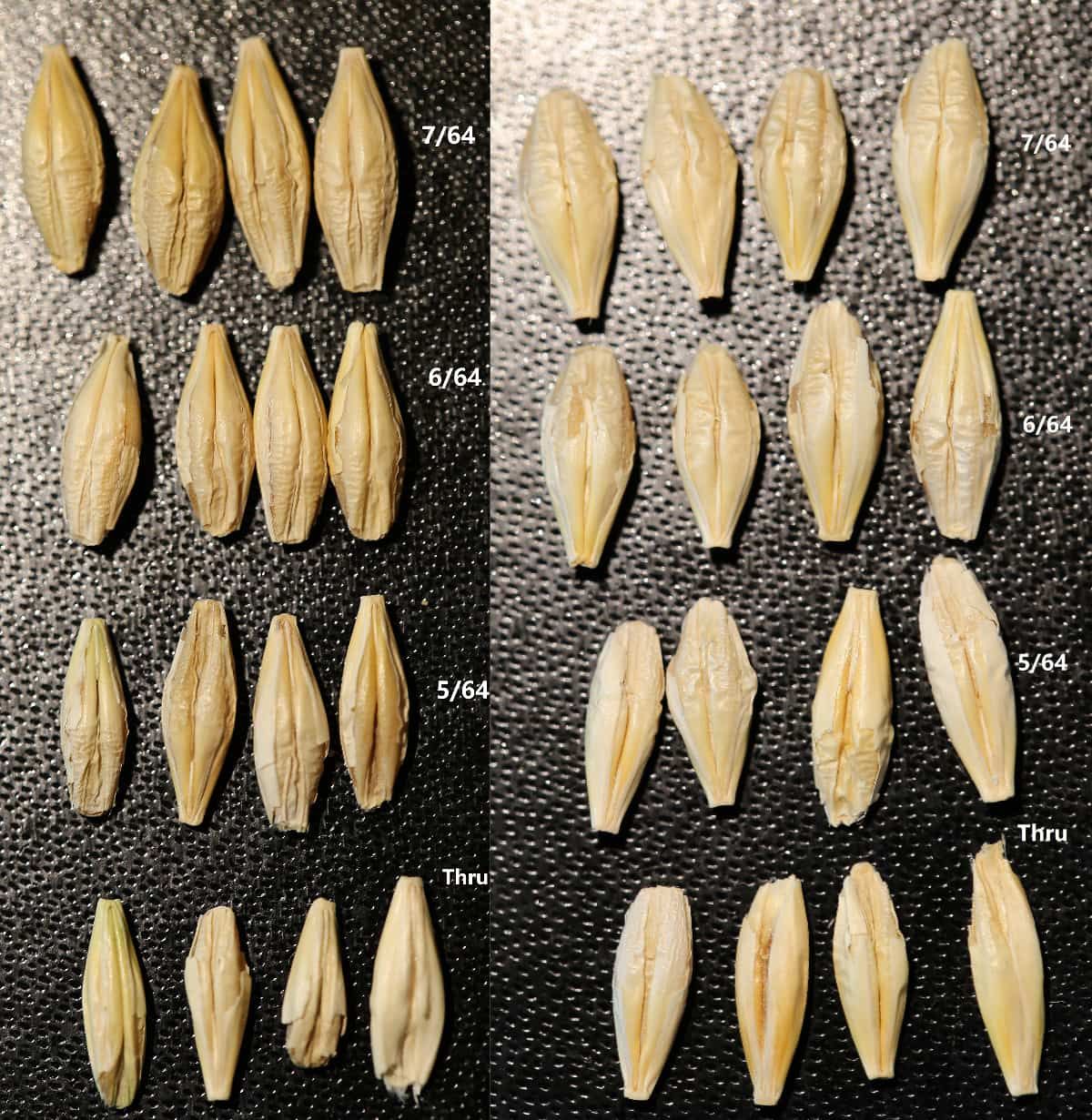
It’s essential to note that the plumpness of barley is determined by a combination of genetic and environmental factors, as well as the cultivation practices used during the growing season. Genetically, different barley varieties have inherent characteristics that define their potential plumpness. In general, two-row barley tends to have greater plumpness compared to six-row barley. Environmental factors such as temperature, rainfall, and sunlight exposure can influence the grain filling period and thus affect the final grain size and plumpness. Barley grown under ideal conditions – adequate rainfall, optimum temperature, and sufficient sunlight – tends to be plumper. Figure 1 illustrates the morphology and plumpness of barley kernels for Expedition and Mayflower, both of which are proprietary varieties of Malteurop. These varieties have been approved by the American Malting Barley Association (AMBA), with Expedition receiving approval in 2013 and Mayflower in 2021.
Understanding the balance between protein composition and grain plumpness, and how they interplay, is key in unlocking the secrets to the influence of barley on malt extract.
In the final section, we’ll tie together these concepts to examine how barley’s protein content and plumpness impact on malt extract. The primary factor affecting malt extract is the starch content, but it is also influenced by other characteristics of the barley kernel, such as hull content and cell wall thickness. Additionally, malt extract can be modified by factors like water absorption, enzyme distribution, and endosperm modification characteristics.
Bishop presented an equation that allows the prediction of extract by using the total nitrogen content and the 1000-kernel weight of a barley sample as determinants. This equation is Extract= Constant-11.0N+0.22G, where N and G are the nitrogen content and 1000-kernel weight, respectively. Our previous research found that plump kernels tend to have higher malt extract content compared to long, thinner kernels within a single barley cultivar.
Having dissected the roles of barley protein and plumpness individually, we now turn our attention to their combined influence on malt extract. It’s in the interplay between protein content and plumpness that we can truly appreciate the fine art of barley cultivation and malt production. A well-balanced barley grain in terms of protein content and plumpness can lead to superior malt extract, which in turn contributes to improved brewing efficiency and beer quality.
The findings presented in Table 1 demonstrate that, for a Metcalfe sample with a barley protein content of 10.6, the plumper sample, constituting 50.4% of the kernel size on the 7/64″ fraction, achieved an Fgdb value of 81.7. In contrast, the thinner sample, accounting for 23.4% of the kernel size on the 7/64″ fraction, exhibited a lower Fgdb value of 79.8. The observed difference between the two samples was 1.9 extract units, indicating that the plumper sample yielded a higher extract content. Interestingly, in the case of a Metcalfe sample with a barley protein content of 13, the plumper sample, comprising 41% of the kernel size on the 7/64″ fraction, achieved an Fgdb value of 80.5. On the other hand, the thinner sample, constituting 27.8% of the kernel size on the 7/64″ fraction, exhibited a substantially lower Fgdb value of 77.6, which was notably 2.9 extract units lower than that of the plumper sample, despite both samples having the same barley protein level. These findings strongly suggest that both barley protein content and kernel plumpness significantly influence the extract level.
 in Metcalfe.png)
In conclusion, the journey from barley to malt extract is a complex and fascinating process, where the interplay of proteins and kernel plumpness plays a crucial role. By gaining a deeper understanding and effectively managing these parameters, we can unleash the full potential of barley, offering brewers exceptional malt that guarantees the creation of flavorful and satisfying beers. MMC’s diligent team is committed to delivering top-quality malt by carefully selecting the ideal protein and plumpness profiles, tailored to meet the diverse needs of our valued customers. Through continuous research and innovation, MMC strives to stay at the forefront of malt production, ensuring that our customers receive the highest standards of quality and consistency in every batch of malt they receive.
1. Bishop, L.R. The prediction of extract. IV. The adjustment of prediction to give true extract in malt. Journal of the Institute of Brewing 1948, 54, 330-333.
2. Paul Schwarz and Yin Li. Malting and Brewing Uses of Barley. In: Barley: Improvement, Production, and Uses. Edited by S.E. Ulrich. Wiley, 2010, 478- 522.
3. Yin Li. Brewing Under Pressure: The Challenges of Drought on the Malting and Brewing Industry. American Society of Brewing Chemists, Beer Buzz, March 2023.
4. Yin. Li, P.B. Schwarz, J.M. Barr, R.D. Horsley. Factors predicting malt extract within a single barley cultivar. Journal of Cereal Science 2008, 48, 531-538.
5. Xiang S Yin. Practical Brewing Sciences-Malt. American Society of Brewing Chemists, St. Paul, MN, 2021.