Pre-Harvest Sprouting in Barley and Its Impact on Malt Quality and Brewing Performance
April 11, 2023

New Distribution Center in The Greater Toronto Area now open!

April 11, 2023
By Dr. Yin Li, Malteurop Malting Company
Dedicated brewers recognize the significance of carefully selecting the finest raw materials to attain the pinnacle of brewing excellence. In the realm of malting and brewing, the selection of appropriate barley is critical to guarantee a smooth and prosperous brewing process. Maltsters meticulously pick the highest quality barley to evade any potential problems. Pre-harvest sprouting (PHS) in barley poses a significant challenge for the brewing and malting industry, resulting in decreased grain quality and yield, and financial losses.
This concise article furnishes an all-encompassing understanding of pre-harvest sprouting (PHS) in barley, its influence on malt quality and brewing performance, as well as prevention and mitigation strategy. The author hopes this article can contribute to the sustainable production of top-quality barley and malt by providing insights into emerging technologies and innovative strategies for mitigating pre-harvest sprouting (PHS).
Pre-harvest sprouting is a phenomenon that occurs when barley grains begin to germinate before harvest. It is most often associated with rainfall and prolonged wet weather after the physiological maturity of grain, although prolonged ripening under cool and moist conditions can result in pre-germination, without visible signs of sprouting. Irrespective of the malting technique employed in the malthouse or pre-harvest sprouting occurring on the plant’s stalk, the process of germination elicits a series of enzymatic reactions that result in a significant transformation of the grain kernel.
The presence of α-amylase is commonly employed as a means of identifying PHS. PHS in barley can have significant technological and economic implications, as it can make the grain more susceptible to a rapid loss of viability. As shown in the picture below, sprout damaged kernels are defined as the loss or near loss of the embryo or the presence of a sprout. Severely sprouted kernels usually will not regerminate. Regarding sprouted kernels that may initially begin to germinate in a malthouse, it is possible that the Germinative Energy (GE) decreases to unacceptable levels during storage. Barley kernels with PHS are often highly sensitive to water, requiring adjustments to the steeping process.
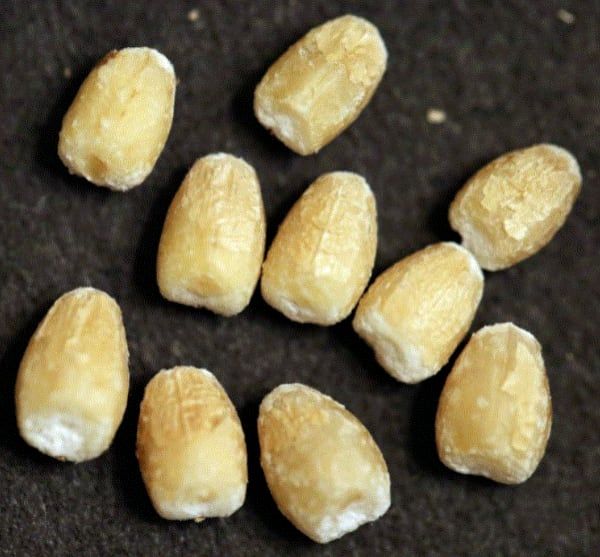
PHS in barley is crucial, and one effective method is to have grains with a trait called dormancy. Dormancy refers to the ability of a seed’s genetic propensity to delay germination for a certain time after the seed has fully matured. The dormancy trait is controlled by multiple genes and can be influenced by various environmental factors.
The level of dormancy in North American barley varieties, along with selective breeding practices. It is the primary determinant of PHS in this region. Barley breeders in North America have historically focused on developing varieties with lower dormancy levels, often referred to as “hotter” varieties. There is an ongoing debate about whether current breeding program practice is responsible for making barley susceptible to PHS. Barley harvest typically takes place in early to mid-August, after which the barley lines are micromalted and evaluated for malt quality in a lab from October to November. The first set of data becomes available in mid- to late November, but early trial results may be influenced by seed dormancy. As a result, there is a concern that the current breeding selection process may inadvertently favor lines with lower seed dormancy.
The goal of malting is to thoroughly alter the barley grain to produce the necessary package of enzymes, break down the barley grain into simplified starch, and degrade the protein into soluble protein and FAN for yeast nutrition. When PHS occurs, the impact of PHS on malt quality is complex and multifaceted. In a study published by the Canadian Malting Barley Technical Centre (CMTBC) in 2011, barley samples with a higher degree of PHS exhibited increased variations in both germination energy (GE) and water sensitivity as storage time increased. During malting, greater PHS led to faster water uptake, but a decrease in chitting rate was observed as storage time increased, especially for samples kept at higher temperatures. Kernels with PHS issues have inconsistent breakage, making water uptake challenging and leading to drowning or delayed growth. If presprouted kernel content is less than 5%, the natural enzyme content of the rest of the barley can take care of issues; however, PHS inclusion as high as 35% makes malting and consistency extremely difficult.
If a portion of the barley kernels before a steeping process has already started to sprout, the process of controlling water uptake becomes more difficult for the maltster. As sprouted kernels have cracks in the husk on either side of the germ and visible embryonic tissue, as shown in the picture, this can lead to quick water absorption at the beginning of the process. This inconsistency can cause some of the kernels to become waterlogged and die, while others may experience delayed growth, leading to further inconsistency. Hydrating a mixture of solid and semi-impenetrable kernels and other kernels with varying water uptake rates, becomes even more challenging for the maltster. Furthermore, this challenge is compounded by the fact that the viability of the barley seeds can quickly decrease depending on the storage conditions, resulting in inconsistent modification levels associated with other quality traits, such as low extract, low fermentability, higher beta-glucan, higher viscosity and fine/coarse extract difference (F-C), and low friability. Highly variable malt modification and brewing performance is less likely to be predicted.

When it comes to brewing, using low-quality malt processed by PHS barley can significantly affect various performance indicators such as brewhouse efficiency, yield, and overall quality. This can result in slower run-off times during the mashing process, reduced extract yield, sluggish fermentation, low fermentability, poor beer stability, and off-flavors in the finished beer. PHS barley produces a higher percentage of non-friable material from less viable and dead kernels, which can exacerbate problems with low yield, low efficiency, and slow lautering. This can increase the brewing process’s cost and impact the brewery’s overall efficiency.
Understanding the impact of PHS on malt quality and brewing performance is important for maltsters, brewers, and consumers. Maltsters can take steps to minimize the impact of PHS on their products by selecting high-quality raw barley, monitoring and controlling malting conditions, and conducting quality testing to assess the suitability of their malt for brewing. Brewers can also take steps to optimize their brewing process and minimize the impact of PHS on their final product by selecting high-quality malt, adjusting their brewing process to compensate for changes in extract yield and fermentability, and conducting quality testing to ensure consistency and quality.
To minimize the risk of PHS and optimize brewing performance, it is important to select high-quality raw barley material. Strategies for selecting high-quality raw barley include: 1. choosing barley varieties that are less susceptible to PHS; 2. selecting barley that has been grown in environments with low moisture and humidity; 3. harvesting and storing barley properly to minimize exposure to moisture; 4. conducting quality testing on raw barley to assess its suitability for malting and brewing.
Preventing the occurrence of PHS is a complex process that necessitates a multifaceted approach comprising breeding and genetic modification, cultural practices, and post-harvest handling and storage techniques. In terms of breeding and genetic modification, there is promise in the development of PHS-resistant barley varieties through traditional breeding or genetic modification. By establishing favorable growing conditions, growers can minimize the risk of PHS in their barley crops. In addition, proper post-harvest handling and storage practices are crucial in preventing PHS. This includes drying harvested barley to a moisture content of 12-14%, as well as storing it in sanitary, dry, and well-ventilated facilities to prevent moisture accumulation.
Pre-harvest sprouting (PHS) can have a significant impact on malt quality and brewing performance. Understanding these impacts is essential for optimizing malt quality and brewing performance and developing strategies to detect and prevent PHS in barley crops. Selecting high-quality raw barley and employing strategies to prevent PHS can help minimize its impact on malt and brewing quality.
MMC’s dedicated team works tirelessly to ensure the highest quality malt production by implementing cutting-edge research and prevention techniques against PHS. Our experts in Research and Innovation, Technical Service, and Quality offer personalized support and tailored services to brewers, reinforcing our commitment to exceptional malt quality and fostering long-lasting partnerships in the industry.