Beer Style Fun Facts: Kölsch
January 24, 2023

New Distribution Center in The Greater Toronto Area now open!
January 24, 2023
Crisp, clean beers seem like a thing of the past in the American craft beer scene of late. But fear not, my craft beer loving friend. While it appears they have taken a back seat to many adjunct heavy craft beers, their light still shines bright as evidenced by the many craft breweries that still focus strongly on traditional styles. Styles such as the beloved Kölsch.
The Kölsch style originated in Köln (Cologne), Germany, during the late 1800s, but the seeds were planted long before the 19th century. Founded in the first century, A.D., Cologne has long since played a historical role when it comes to the history of German beer.
Perhaps the most transformative history came in the early 1600’s when this western German city made the momentous decision to no longer brew using the traditional lagering methods that were embedded into Germany’s culture at that time. For reasons not immediately clear – maybe due to lack of refrigeration abilities or maybe just a desire to buck the norms – Cologne passed a law allowing only top fermentation to occur. Only ales were allowed to be brewed.
This paved the way for today’s style known as Kölsch. Pale lagers were making their way into the city from Bohemia. Cologne responded by crafting their own pale beer. Continuing the tradition (law) that was instituted in the 1600’s, the brewers in Cologne used warm-fermenting ale yeasts to create a golden, hoppy, and crisp beer. The modern day Kölsch was born.
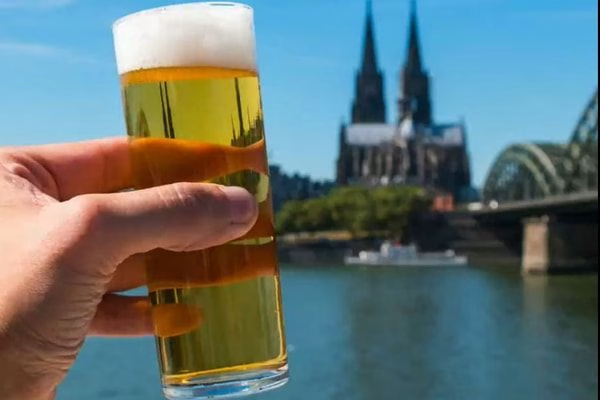
Fast forward to the 1980s. Cologne’s brewers renewed the definition of their beer. A true Kölsch is “a light-colored, highly fermented, strongly hopped, bright, top-fermented Vollbier.” They went even further defining how it was to be served, as well – in a 0.2 liter (6 ounce), tall, straight Stange (meaning rod) glass. And it was only to be crafted in Cologne.
You now know where Kölsch originated from, but what exactly is a Kölsch? It could be an ale as it is a top-fermented beer using an ale yeast and fermented at warm temperatures. But it also shares characteristics of a lager because it spends a few weeks to a few months at colder temperatures, too. Not exactly an ale or a lager, this complex beer is often referred to as a hybrid.
The hybrid fermentation process gives the Kölsch a light and drinkable character with a malt forward taste. Its flavor profile hints at fruit essences, alongside subtle fruit aromas such as cherry, apple, and wine-like fragrances. It finishes smooth, crisp, and slightly dry and is golden in color with an ABV around four to five percent.
The BJCP describes it best in a precise definition: “A subtle, brilliantly clear, pale beer with a delicate balance of malt, fruit, and hop character, moderate bitterness, and a well-attenuated but soft finish.”
What isn’t often mentioned when it comes to a Kölsch, is the fact that for it technically to be called a Kölsch, it has to come from Cologne, Germany. Drinking a beer straight from its source is an ideal way to fully experience and appreciate its true heritage and flavors.
However, since we can’t all make it to Germany, American brewers have taken it upon themselves to embrace the style in the U.S. And we’re thankful for that. After all, kicking back with a Kölsch isn’t just for the Germans.
Although it is the Germans and their knowledge of brewing that brought us clean, crisp beers using only essential ingredients, it is also the Germans that helped shape the glassware for serving a Kölsch.
Traditionally, Kölsch served in Cologne is served by Kobes – male bartenders working in Cologne’s pubs in blue aprons and a leather pouch. Blunt and forward speaking, they only serve Kölsch, so don’t bother asking for anything else.
And that Kölsch is only served in a tall and narrow glass called a Stange that holds around six ounces of beer. This glass helps to show off the clarity of the beer as well as ensuring that your beer won’t go cold and stale. It’s too small of a pour for that to happen.
Be forewarned, though, once you polish off your almost pint, you’ll automatically get another. Unless you place your coaster over your beer when done, you might just be stuck at the pub all day drinking continually cold beer. There are worse places to be.
While you may not experience this style of serving at American craft breweries, we can at least be thankful for the American style Kölsch. They might be served as a full pint in the U.S., but we can handle drinking it before it gets warm and stale.
Here’s to leaving the coasters on the table and not on top of the glass!
*****
From pilsner malts to Vienna, Munich, and wheat malts – it’s the malts that make up the prominent taste in a Kölsch. Here at Malteurop we pride ourselves on our high quality and diverse malts. Malts that are a perfect match for a Kölsch and all the beers you diligently work to perfect. Click here to learn more.
https://www.foodandwine.com/drinks/what-is-kolsch
https://draftmag.com/kolsch-beer/