The Kölsch of Cologne, Germany: a beer styles by region series
January 15, 2025

New Distribution Center in The Greater Toronto Area now open!

January 15, 2025
Culture encompasses all aspects of a society including the region of Cologne in Germany and its Kölsch. From the natural land to the learned behaviors of its inhabitants, culture formulates our spiritual, natural, and physical selves.
It makes sense then that different cultures and regions of the world, alongside distinct beliefs and values, there would also be distinct flavors. And many of those flavors reside in beer.
“Drinking a Kölsch is more than just drinking a beer: it’s like drinking an entire culture.” (Cologne Tourism)
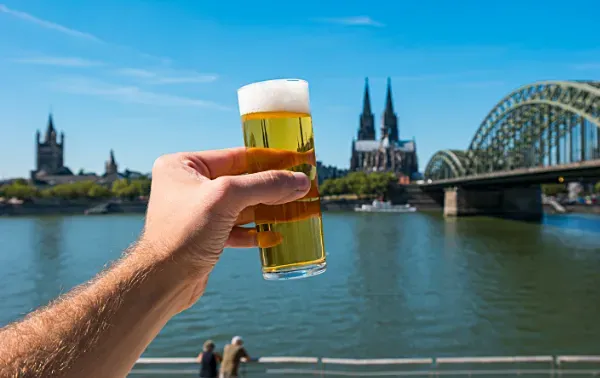
Cologne (Köln in German), Germany, is a modern day city of around one million people. Located on the west bank of the Rhine River, Cologne was a natural transportation hub from its beginnings in the year 38 BCE. From its origins founded by the Romans, to its status as the capital of the Gallic Empire in the 3rd century, to Germany’s now fourth-largest city, Cologne has flourished.
Hosting one of the largest Carnival events in Europe, along with many other festivals and happenings, Cologne is a welcoming city steeped in tradition. Especially when it comes to its beer.

Kölsch is a beer, yes, but it is also the name of the local dialect. And one can’t help but put two and two together, resulting in a common proverb amongst Cologne’s people.
“Kölsch is the only language you can drink.” (New World Encyclopedia)
So, let’s drink!
The BJCP (Beer Judge Certification Program) describes the characteristics of a Kölsch best in a precise definition: “A subtle, brilliantly clear, pale beer with a delicate balance of malt, fruit, and hop character, moderate bitterness, and a well-attenuated but soft finish.”
IBUs: 18-30 | SRM: 3.5-5 | OG: 1.044-1.050 | FG: 1.007-1.011 | ABV: 4.4%-5.2%

But where did the Kölsch come from? For some unknown reason, in the 1600s, the people of Cologne decided that the long-standing traditional bottom-fermenting lagering methods were no longer to be utilized.
And with pale lagers becoming more common across the land, Cologne didn’t want to blend in. Instead, the brewers in Cologne responded by crafting their own pale beer. Staying true to the top-fermenting standards set, they used warm-fermenting ale yeasts to create a golden, hoppy, crisp, clear beer conditioned at cold temperatures similar to a lager.
But it wasn’t until 1918, when Sünner Brauerei brought the first modern-day Kölsch to market and labeled it as such.
Fast forward to 1986 during the Kölsch Convention, where 24 breweries from Cologne alongside the German government convened with a goal of preventing outside brewers from cashing in on the popularity of this beer style.
This long-standing clear, crisp lager was granted protection status. Like Bourbon from Kentucky or Champagne from the Champagne region in France, a Kölsch is not considered a true Kölsch unless it is brewed in Cologne within 30 miles from the city. Being in Germany, it must also follow Reinheitsgebot.
But that’s not all that defines a Kölsch. Being a beverage that encompasses an entire culture and language, one cannot simply drink a Kölsch out of a pint glass!
Picture this: You walk into a pub in Cologne, excited to experience a Kölsch in its truest form. Glancing up, you notice ornate chandeliers dancing above you, giving off a soft glow of light that reflects off the many colorful displays of stained glass windows. Surrounded by delicate etchings and vintage photos, you can’t help but feel welcomed in.
That is, until your waiter serves you. Known as Köbes, the waiters in a traditional pub in Cologne have more gruff than grin, and that is exactly how it’s supposed to be. Chalk it up to Cologne’s culture, but don’t consider their behavior rude, it’s just a part of what makes Cologne, well…Cologne.
Tradition is strong here, and that holds true with the Köbes’ garb as much as the beer. Donning a blue knitted jacket, complete with a high collar and a double row of black buttons, these waiters won’t be mistaken for just another face in a crowd. Black trousers, blue apron, and a leather pouch round it all out for good measure.
But the tradition doesn’t stop there. While the clothes might be a giveaway, it’s really the attitude that says it all. That and the round tray of beer constantly in his hands as he moves quickly and surreptitiously through the room, delivering crisp, fresh pours of Kölsch alongside his wittingly dry sense of humor.
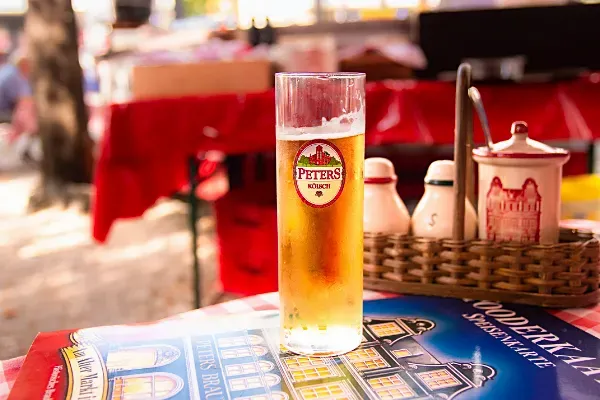
And speaking of pours, in a city that has beer as a part of its vibrant history and culture, this beer will always be fresh. And to guarantee that, the vessel of choice when it comes time to be served that refreshing Kölsh is not a pint glass, No, this beer deserves the very finest and most purposeful glassware – a Stange.
A Stange is a tall and narrow glass, holding about six ounces of beer. The purpose? It helps to highlight the clarity of the beer. But more importantly, the small size ensures that your beer will always be fresh and cold.
Be forewarned, though, to keep that beer fresh and cold, unless you place a coaster over your cup, once you polish off your Stange full of Kölsch, you’ll automatically get another.
Which is exactly why, when visiting a pub in Cologne, you’ll see those well-dressed waiters constantly rushing around with a round tray of glasses full to the brim with Kölsch. Which might also be why the Kobes are a bit snarky.
Wouldn’t you be if you were surrounded by patrons enjoying a Kölsch without you?

Today, Cologne is home to more than 20 breweries, even though only a handful of the 24 original breweries that participated in the Kölsch Convention of 1986, remain.
But those that do, and the new ones since, stay true to the beer that defines Cologne – the Kölsch. In fact, here in Cologne, while other styles of beer are served, almost 50% of the Kölsch style is sold on draught, double the average for all other beers sold on tap.
And regardless of the brauhaus you find yourself in, that draught will be served straight from a wooden barrel, keeping this beer top of the list for tourists and locals alike.
Of course, the best way to experience the culture of Cologne through its Kölsch is at its source.
But when we can’t get there, we are grateful for the brewers that work diligently to brew the Kölsch of Cologne right in our backyard (even if it’s not technically a Kölsch.)
That’s the kind of language we can all understand.
To read more on Kölsch, click here.

Premium grains from field to flavor.
– – – – –
Malteurop Malting Company (MMC) is based in North America—specializing in growing and producing quality malts for the beer, whiskey, and food processing industries. With local farms and Malthouses spread across the United States, Canada, and Mexico, Malteurop’s commitment to excellence is fully ingrained into every batch it produces, ensuring businesses of any size can create the finest beverages and food products on the planet.
Visit www.malteuropmaltingco.com to learn how we can support your malting needs.
Contact us at customersuccess@malteurop.com or (844) 546-MALT (6258) for questions or to place your order.
Malting is our passion. Quality is our promise.
– – – – –
https://tempestinatankard.com/2023/06/15/cologne-and-its-kolsch-a-rough-and-ready-guide/
http://europeanbeerguide.net/kolnbrew.htm
https://auslanderblog.com/kolsch-beer-guide-cologne/
https://www.cologne-tourism.com/delight-diversity/gastronomy/breweries