Non-alcoholic beer is growing; Should your brewery grow with it?
November 30, 2023

New Distribution Center in The Greater Toronto Area now open!

November 30, 2023
Non-alcoholic beer production has reached an evolutionary point that really good NA beer can and is being made. That and the sober curious have led to significant movement in the NA market. But is NA beer the correct opportunity for your brewery? There’s a lot to know about non-alcoholic drinkers and NA production before you make that decision.
Today’s non-alcoholic beer is not your parents’ Near-Beer. There is a new horizon brewing for non-alcoholic beer.
There has been more innovation in producing non-alcoholic beer over the past few years than there has been in decades. The result? More and better options than ever before. Once relegated to mostly bland, less flavorful options, non-alcoholic beer is surging in popularity.
But what is this new revolution in NA beer? Who is drinking it? How is it made? And most importantly, where is it headed?
The good news? There is a lot of room for opportunity and growth. But perhaps the biggest question of them all, at least for breweries, is should you be jumping into this fast-paced market segment?
Most countries define non-alcoholic beer as a beverage that contains no more than 0.5% alcohol by volume. This means that many are not truly 100% alcohol-free beers. But to put that in perspective, many fruit juices on the market contain a similar amount of alcohol. Some juices even bump up toward the 1% ABV mark.
Non-alcoholic and low-alcohol beer have deep roots. During medieval times, small beers or table beers were often produced from the second runnings of a full strength batch of beer. These small beers frequently clocked in at about 2 to 3% ABV.
Part of the reasoning for these small beers was the lack of safe drinking water. It was often safer to drink a small beer with little alcohol than the water that was available.
Non-alcoholic beer in the U.S. got its start during the Prohibition Era in the early 1900s. From 1920 through 1933, no production of intoxicating beverages with an alcohol content above 0.5% ABV was allowed.
Several breweries during Prohibition brewed beer and then boiled off the alcohol so that it remained below the 0.5% ABV threshold. This became known more commonly as near-beer.
Drinking non-alcoholic beer during Prohibition had an obvious impetus. Alcoholic beverages were deemed illegal, so it was the closest many people could get to the beer they were drinking before it was banned. Today, non-alcoholic beer is more generally considered an option for people that want or need to avoid alcohol or people that see it as a healthier option.
There are many people that because of medical-related issues, cannot or choose not to drink alcohol. But there are many others for whom it is simply a lifestyle choice for one reason or another.
Most non-alcoholic beers have a lower calorie count than their fully fermented siblings. That’s one check for the health conscious consumer. The lack of alcohol is another check in the plus column for people that don’t want to deal with the negative aspects of consuming alcohol, such as dehydration and hangovers.
Interestingly, one of the largest segments consuming non-alcoholic beverages these days aren’t teetotallers, but the sober curious.
“Sober curious simply means that you’ve chosen to avoid alcohol for personal or wellness reasons. It involves curiosity about the reasons fueling your desire to drink and the way alcohol affects your life,” according to healthline.com.
So, it’s not necessarily drinkers that don’t want to drink alcohol at all. They’ve just made a decision to consider their alcohol consumption more thoughtfully.
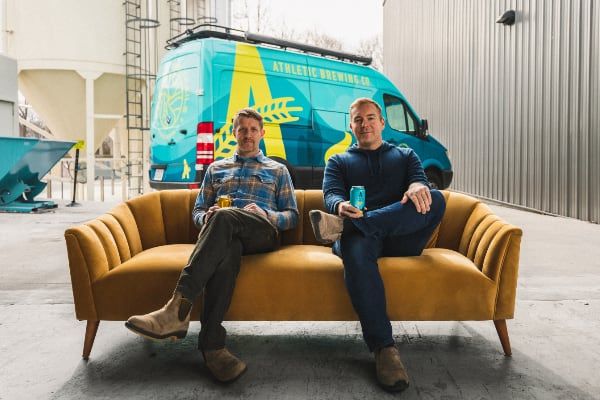
“80 percent of our drinkers do drink alcohol at other occasions. So the trend of, they call it zebra striping, where people drink alcohol, non-alcohol, alcohol, non-alcohol throughout a night to pace out their session, moderating their ABV intake has become increasingly common,” Bill Shufelt, Co-Founder & CEO of Athletic Brewing Company, told Bloomberg. That stat has been corroborated by Bart Watson, the Brewers Association’s chief economist.
So there is maybe a little bit of a different market for non-alcoholic beer than many of us might have originally thought, especially if you are a drinker of fully fermented beer. But are there really that many people that are drinking non-alcoholic beers?
That is all based on perspective. Currently, the share of the market is relatively small. Non-alcoholic beer makes up around 0.7 share of total beer dollar sales and 0.6 share of volume sales, according to Watson.
Those numbers aren’t massive, but they’re not irrelevant, either.
The segment of non-alcoholic beer sales is also growing at a steady clip. While craft beer has been relatively flat in terms of growth, non-alcoholic beer share has roughly doubled in the last three years. That’s not exponential growth, but it is enough of a steady pace that Watson believes the non-alcoholic beer sector will continue.
With non-alcoholic specific breweries like Athletic Brewing Company leading the charge, several significant craft brewers have joined in driving innovation in what was for a long time a stagnant segment. The likes of Boston Beer Company, Dogfish Head, Sierra Nevada, and Brooklyn Brewery have all released NA beers.
Market share, growth projections, and potential revenue are all enticing when moving in a positive direction. But just because there is an opportunity to be had doesn’t necessarily mean you should dive into the deep end of the pool.
There are many other factors to contemplate before committing to non-alcoholic beer production. Chief among them are the learning curve, cost, and food safety considerations.
While well produced fully fermented beer innately comes with a fair amount of food safety because of its inclusion of alcohol, non-alcoholic beer is not afforded such a luxury. In fact, NA beer is quite the opposite. It lacks many of the safeguards of fully fermented beer.
Non-alcoholic beers are typically lower in or even lacking bittering hops, which have some natural preservative qualities. They also have a high concentration of sugars and may have an elevated pH level, which can support microbial contamination.
It’s important to utilize preservation techniques to make sure that non-alcoholic beer is food safe and shelf stable. The main ways to ensure the food safety of non-alcoholic beer are to use methods such as pasteurization, sterile filtration, or chemical preservatives.
The pH level of non-alcoholic beer should also be controlled. Maintaining a pH of 4.6 or lower helps prevent microbial contamination of non-alcoholic beer.
The learning curve for making non-alcoholic beer includes everything from designing the correct recipes for NA beer to production methods to food safety. The actual production process you opt for will shape your recipe design, which can be vastly different from recipe design for a fully fermented beer.
The methods of manufacturing non-alcoholic beer fall into two basic categories: preventing alcohol from being made or removing alcohol post-fermentation (also known as dealcoholizing). Each has its challenges.
Preventing alcohol from being made
Limited or Arrested Fermentation is when fermentation is stopped before the level of alcohol goes above the 0.5% ABV limit. This typically requires a recipe and process that produces less fermentable sugars for the yeast to convert into alcohol.
Another way to help arrest fermentation is by cold crashing the fermenting beer to nearly freezing temperatures, deactivating the yeast before too much alcohol is created.
Limited Fermentation can also be achieved by utilizing specially designed yeast strains – such as Lallemand’s LalBrew LoNa – which limit the consumption of sugars such as maltose. These sugars would have been converted into alcohol by a normal brewer’s yeast.
These specially designed yeasts limit alcohol production, while maintaining the positive qualities of fermentation, allowing the malt and hop flavors to come through.
Removing alcohol post-fermentation (Dealcoholization)
Alcohol boils off at a lower temperature than water. So a fully fermented beer can be heated to the point (173.1 degrees fahrenheit) that the alcohol evaporates, but the water remains. It is one of the simpler methods that can be utilized to create non-alcoholic beer. But the amount of heat in this method also tends to affect the flavor and aroma of the resulting beverage.
Vacuum Distillation is very similar to the boiling method. Once again, the beer is heated to the point of boiling off the alcohol. However, when utilizing the vacuum method, creating a vacuum substantially lowers the temperature required to boil off the alcohol, from 173.1 degrees fahrenheit down to 93.2 degrees fahrenheit. The lower temperature required in this method has less of an effect on the flavor and aroma of the resulting non-alcoholic beer.
Membrane Filtration is one of the more effective ways of creating non-alcoholic beer that retains most of the color, flavor, and aroma properties that you would want in your brew.
A fully fermented beer is run through a membrane filter that separates the alcohol, color, and some flavor and aroma compounds from the water. The alcohol is distilled off and then the water added back in with the other compounds.
Reverse Osmosis is a common type of membrane filtration that passes the beer across a membrane under high pressure, separating water and alcohol from the beer. Deaerated water is added back into the beer concentrate, along with more water that dilutes the concentration until it reaches the appropriate ABV level.
Important Reminder: It can’t be stressed enough that regardless of which method is used to produce a non-alcoholic beer, the resulting beverage requires preservation techniques. Without enough alcohol to keep it safe, a non-alcoholic beer requires preservation methods such as pasteurization, sterile filtration, or adding chemical preservatives.
While simply boiling off the alcohol in a fully fermented beer is probably the quickest, easiest, and least expensive way to make non-alcoholic beer, it is also known to produce some of the worst finished results. The non-alcoholic beer market was stagnant for a long time because there was no innovation moving away from this method.
There are now many other methods to produce colorful, flavorful, aromatic non-alcoholic beers that taste good. But much of that innovation requires a significant investment in equipment, especially for small to mid-sized craft breweries that have already likely invested heavily in their regular brewing equipment.
Developments like the specialty yeasts that can produce a finished beer without a significant amount of alcohol could be a game changer, especially for small and mid-sized breweries that might not have easy access to the capital required for non-alcoholic-beverage specific equipment. But it is still too early to know how much of an impact it will eventually have.
Even if you already have all your ducks in a row for brewing; federal, state, and/or local municipalities might require additional permitting or licensing depending upon which method of non-alcoholic production you employ.
These may include, but are certainly not limited to, requirements such as a distiller’s permit or license, a food manufacturing permit or license, or non-alcoholic beverage permit or license. If you intend to produce non-alcoholic beer, make sure you fully understand what permits or licenses are required in your area.

Whether or not your brewery should make non-alcoholic beer, of course, isn’t a question that we can answer. All we can do is lay out the facts.
And the facts are that non-alcoholic beer production has reached an evolutionary point that really good NA beer can and is being made. That and the sober curious have led to significant movement in the NA market, which is likely to continue growing, especially with NA specific and craft brewers driving innovation in terms of quality and variety.
But you’ll have to make the final call yourself. What are your goals in considering NA beer? Do you have the resources and knowledge or the time to acquire either or both? Are you jumping on a trend or truly interested in committing to this growing segment of the beer market, which comes with many of its own unique challenges that are quite different from traditional beer brewing?
These are all things to ponder when considering a move into the non-alcoholic beer market. The audience is there and it’s growing, but is it the right audience for you and your brewery?
* * * * * * * * * * * * * *
Regardless of whether you are brewing non-alcoholic beer, fully fermented beer, or both, Malteurop (MMC) is here for you with a wide selection of North American grown and processed malts to help you achieve the best results possible.